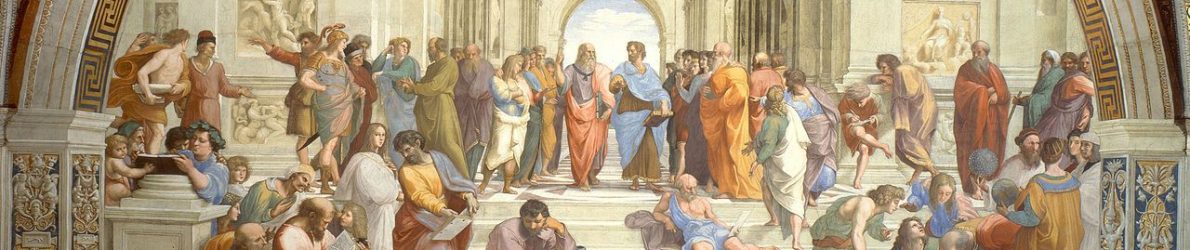
“All the world’s a stage, And all the men and women merely players: They have their exits and their entrances;” — Shakespeare “As You Like It” “There are such curtains which drop down in life. God is passing to the next act.” — Victor Hugo “Les Misérables” The notion that the world is a stage didn’t originate with Shakespeare. Many ancient Greeks and Romans recognized their roles and played them […]
Read moreLatest Post
“On Ends” by Cicero
[Original Latin Title: De Finibus Bonorum Et Malorum; Volume XVII of Loeb Classical Library’s 28-volume series] An Epicurean’s Criticism of Education “[Epicurus] refused to consider any education worth the name that did not help to school us in happiness. Was he to spend his time in perusing poets, who give us nothing solid and useful, but merely childish amusement? Was he to occupy himself like Plato with music and geometry, […]
Read more“Philosophical Fragments” by Søren Kierkegaard
How Far Can We Know the Truth? In Plato’s Meno, an argument is raised that there is no such thing as a “truth seeker”, because if a man knows the truth already, there is no need to seek, and if he doesn’t, he can’t seek, since he wouldn’t recognize it even if he stumbles upon it. Socrates’ solution to Meno’s paradox is Recollection, i.e., the soul, which is immortal, already […]
Read moreBertrand Russell on Love
“Of all forms of caution, caution in love is perhaps the most fatal to true happiness.” –Bertrand Russell “The Conquest of Happiness” Russell, when asked what he would say if he died and found himself confronted by God, whose Love he had refused to believe and accept, was quoted to have said, “Not enough evidence, God, not enough evidence.” “For God so loved the world that He gave His only […]
Read more“The Verrine Orations II” by Cicero
Enmity of Ideals But can you, Hortensius, continue to ask me, the man being what he is, what feelings of private enmity, what personal wrong, can have led me to undertake his prosecution? … Why, think you that any enmity between human beings can be more bitter than such as arises from the conflict of their ideals, from the diversity of their aims and purposes? Can one who reverence modesty […]
Read more“The Verrine Orations I” by Cicero
Cicero, The Professor and the Artist Cicero’s writings need little or no introduction. His erudition, eloquence and fluid writing style give the readers instant familiarity with the historical and political background of his times. His defense and prosecution speeches are like lectures given in court. Cicero the Professor teaches the jury and his opponents the meaning of justice and propriety, and demonstrates how to execute justice, by arguments of moral […]
Read more“The Jugurthine War; The Conspiracy of Catiline” by Sallust
With a few changes in names, the whole story of “The Jugurthine War” can perhaps be transplanted from 110 BC Rome to the 20th century, or any other period in history, when there are global/central super powers, local tyrants/warlords and puppet governments. “The Conspiracy of Catiline” is a tale of political intrigue and class struggle instigated by lust-crazed individuals. It complements Cicero’s account of the event in his orations “Against […]
Read more